
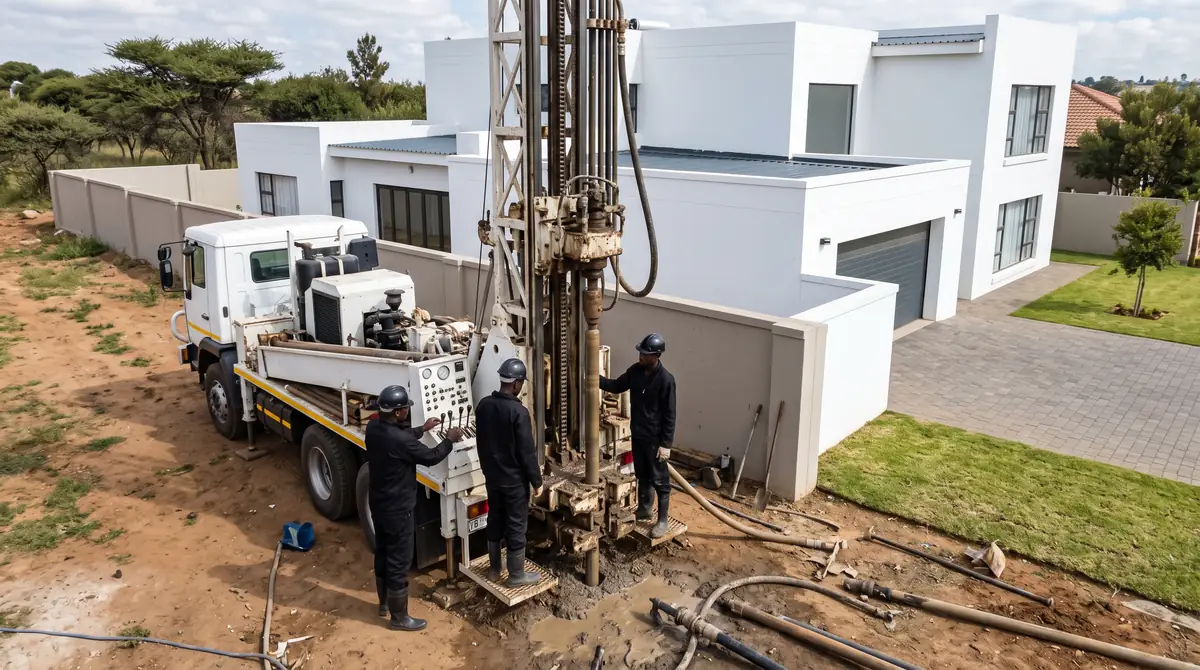
Borehole Drilling is the first step to your own groundwater supply: a rig drills down to water-bearing rock, the hole is cased where needed and the borehole is developed so it is ready for a pump. It suits homeowners, smallholdings, farms, schools and businesses that want water independent of the municipal supply.
- Say what the water is for: household backup, garden, livestock or business use.
- Give your town or suburb and describe rig access to the drilling spot.
- Say whether you want drilling only or a complete drilled-and-equipped borehole.
Describe your site once and compare quotes from borehole drillers.
Compare Borehole QuotesWhat a Drilling Quote Covers
Usually included
- Moving the rig to site and setting up.
- Drilling at an agreed rate per metre, usually 165 mm diameter for domestic holes.
- Casing through soft or broken ground near the surface.
- Development by air-lifting until the water runs clear.
- A borehole cap and basic completion record: depth, water strike, casing length.
Usually extra or excluded
- A geophysical siting survey.
- Extra casing, steel casing or screens beyond the quoted metres.
- Yield testing and water quality testing.
- Pump, cabling, controls, tanks and plumbing.
- Cleaning up drill spoil, repairing paving or lawns, and municipal application fees.
Ground Conditions and Drilling Methods
- Hard rock. Most domestic boreholes are drilled by rotary air percussion into fractured granite, sandstone or quartzite.
- Soft or collapsing ground. Sand, clay and weathered rock need casing driven or installed as the hole advances.
- Dolomite. Parts of Gauteng and the North West sit on dolomite, where sinkhole risk means some municipalities ask for a stability assessment before drilling.
- Coastal sands. Shallow water may suit a wellpoint instead of a drilled borehole.
Casing and Completion
- PVC casing is common for domestic boreholes. Steel casing is used through unstable ground and at the collar.
- Slotted casing or screens let water in while holding back sand.
- A sanitary seal at the top keeps surface water and contamination out.
- The completion record should state final depth, water strikes, casing type and length, and rest water level. Keep it for pump sizing and future repairs.
Permissions Before You Drill
Three separate things can apply, and they are often confused:
- National water use. Reasonable domestic use, watering a small non-commercial garden and watering livestock within normal grazing limits fall under Schedule 1 of the National Water Act. The Department of Water and Sanitation (DWS) says Schedule 1 use does not need registration. Use beyond Schedule 1 falls under a general authorisation or a licence, and may need registering, depending on volume and catchment.
- Municipal by-laws. Some municipalities have their own rules. The City of Cape Town asks you to apply at least 14 days before sinking a borehole or wellpoint and to register it. The City of Johannesburg requires an application and a drilling certificate before drilling starts. Check with your municipality.
- Proposed groundwater regulations. DWS published draft Regulations for the Protection and Management of Groundwater Resources for comment in December 2025. They are proposals, not law, until finalised.
Ask the contractor what they will handle and what you must apply for yourself. Selling borehole water needs DWS permission.
The Drilling Process
- Site visit. The driller checks rig access, slopes, overhead cables, septic tanks and buried services.
- Siting. A position is chosen from local borehole records, geology or a borehole survey.
- Drilling. The rig drills, logs water strikes and installs casing. Most domestic holes take one to two days.
- Development. The hole is blown clean with compressed air and a rough airlift yield is noted.
- Testing. A yield test sets the safe pumping rate, and a water test shows what the water is suitable for.
- Equipping. The hole is fitted with a pump and controls through borehole equipping.
Borehole Drilling Prices
| Item | Ballpark price |
|---|---|
| Drilling only, per metre: Bloemfontein, Polokwane, Nelspruit | R290 - R540 |
| Drilling only, per metre: Durban, Gqeberha, East London | R310 - R600 |
| Drilling only, per metre: Johannesburg, Pretoria, Cape Town | R350 - R750 |
| Casing, per metre (PVC to steel) | R400 - R700 |
| Dolomite stability assessment, where required | R5,000 - R15,000 |
| Complete domestic borehole, drilled, cased, equipped and tested | R60,000 - R120,000 |
Ballpark figures, not quotations. Ranges compiled from price guides published by South African contractors, suppliers and quote websites, checked October 2026 and rounded where needed. They are not our prices and no contractor is bound by them. Confirm whether VAT is included on every quote.
Sources:
- OurPower, borehole drilling cost by city (October 2026)
- Lekker Trade, borehole drilling cost per metre (October 2026)
- Borehole Hub, borehole prices 2026
- Enviroleg, borehole price and drilling price guides (2026)
For depth-based budgets and every add-on, see borehole drilling prices.
What Affects Borehole Drilling Quotes
- Depth to a reliable water strike.
- Hardness of the rock and how much casing the ground needs.
- Distance to site and rig access.
- Hole diameter for larger pumps.
- Whether testing, pump and storage are in the same price.
Questions to Ask Borehole Drillers
- What is the rate per metre, and what is the maximum depth before you stop and consult me?
- How many metres of casing are included, and what type?
- What do I pay if the hole is dry or the yield is too low to use?
- Is a yield test included, and how long does it run?
- Will I get a written completion record?
- Who handles municipal applications, and are you registered with any industry body?
Compare borehole drilling contractors through Borehole Installation South Africa, or go straight to related work below.
Other Borehole Services
Borehole Drilling FAQs
How deep will my borehole be?
It depends on local geology. Many domestic boreholes are between 40 m and 120 m. Neighbouring boreholes are the best guide, and the quote should cap the depth before the driller consults you.
Can you guarantee water?
No contractor can guarantee water, yield or quality. Agree the dry-hole terms in writing before drilling starts.
How long does drilling take?
Drilling a typical domestic borehole often takes one to two days. Testing, equipping and permissions add time.
Will the rig damage my garden?
Rigs are heavy and drilling throws out water and rock chips. Ask how the driller protects paving and lawns, and who cleans up.
What is the difference between borehole drillers and drilling contractors?
Nothing practical. Some drill only, others also test, equip and install storage. Compare what each quote includes.
Is borehole water safe to drink?
Not automatically. Have it tested by a laboratory before drinking it, and treat it if the results call for it.
Borehole Installation South Africa is a free quote-comparison service. The drilling is quoted and carried out by independent contractors, and your agreement is with the contractor you appoint. Availability depends on your location and on contractors taking on that kind of job. Before you pay a deposit, get a written quote that lists what is included and excluded, the guarantee terms and the payment terms.
Borehole Drilling. Describe your site once and compare quotes from borehole drilling contractors.
Compare Borehole QuotesCompare Borehole Drilling Quotes
Client Reviews
Powered by leaderr